
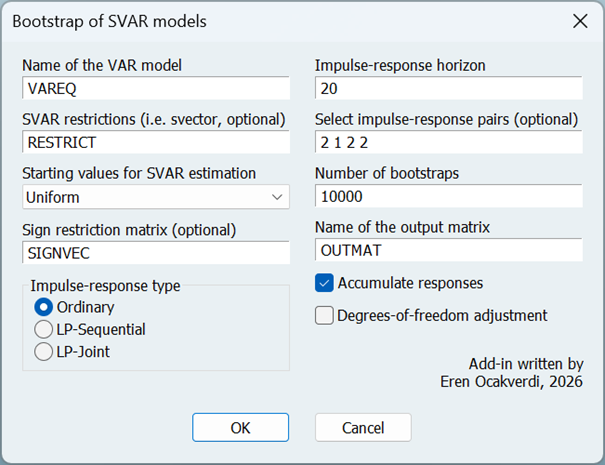
This blog piece intends to introduce a new add-in (i.e. BOOTSVAR) that extends the current capability of EViews’ available features for obtaining bootstrapped draws of impulse response functions from structural VAR estimations.
Table of Contents
- Introduction
- Residual Based Bootstrapping
- Application to Estimation of Sacrifice Ratio for Turkish Economy
- Files
- References
Introduction
Impulse-response analysis is the most preferred way to reveal the interaction between the variables of interest modelled through regular or structural VAR analyses. The uncertainty in the estimation process is depicted by the confidence intervals, which is usually determined by bootstrap methods as they maintain the contemporaneous relationships among residuals.Residual Based Bootstrapping
Suppose that we have the following underlying data generating process (DGP): \begin{align*} A_0 y_t = A_1 y_{t-1} + \dots + A_p y_{t-p} + u_t \end{align*} Here, $y_t = [y_{1t}, y_{2t}, \ldots, y_{mt}]'$, $A_i$ are $(m \times m)$ coefficient matrices and $u_t = [u_{1t}, u_{2t}, \dots, u_{mt}]'$ white noise disturbance matrices. The bootstrap algorithm is then as follows:- Estimate the model to obtain model parameters ($\hat{A}_0, \hat{A}_1, \ldots, \hat{A}_p$) and store the residuals ($\hat{u}_t$).
- Compute the centered residuals: $\hat{u}_t - \frac{1}{T} \sum_{t=1}^{T} \hat{u}_t$.
- Start the bootstrap loop:
- 3a) Randomly draw with replacement from centered residuals to generate new bootstrap residuals ($u_t^* = [u_{1t}^*, u_{2t}^*, \dots, u_{mt}^*]' $).
- 3b) Generate new bootstrap time series: $y_t^* = \hat{A}_0^{-1} \left(\hat{A}_1 y_{t-1}^* + \dots + \hat{A}_p y_{t-p}^* + u_t^* \right)$.
- 3c) Re-estimate the coefficient matrices based on the new bootstrap time series and obtain the impulse response coefficients.
- 3d) Repeat the steps a to c for a large number of times.
Application to Estimation of Sacrifice Ratio for Turkish Economy
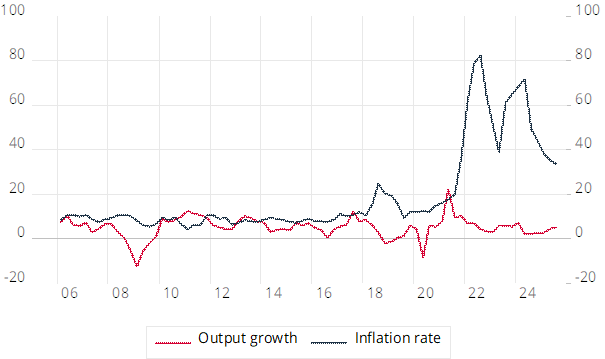
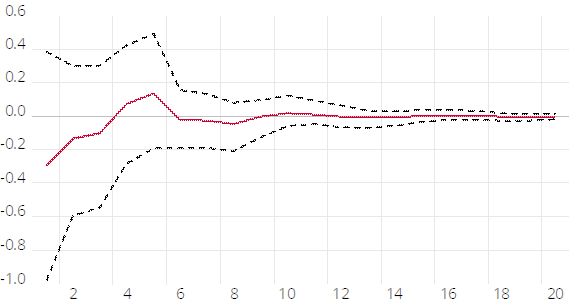
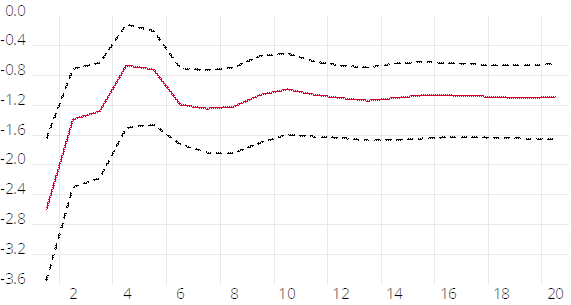
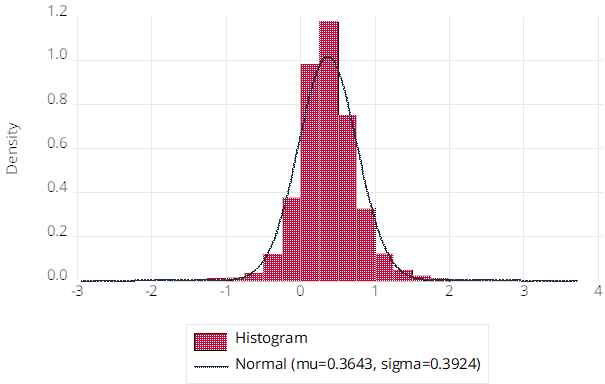
The sacrifice ratio is a macroeconomic concept that addresses the cost of reducing inflation in terms of lost output. It is usually calculated under the assumption that monetary policy is implemented to permanently bring the inflation rate down (i.e. by 1 percentage point) and the tradeoff will be a cumulative loss in the output (i.e. % of GDP).Example here is based on the two-variable structural VAR model of Cecchetti and Rich (2001), where the system includes only inflation and output. Turkish CPI and GDP figures over the 2005q1-2025q3 period are used in the analysis (see Figure 1).
 |
|
|
 |
|
|
 |
|
|
 |
|
|
 |
|
|
Files
References
- Cecchetti, S. G., and Rich R. W. (2001), "Structural Estimates of the U.S. Sacrifice Ratio", JBES, vol. 19, no 4, 416-427.
- Lütkepohl, H., (2000), "Bootstrapping impulse responses in VAR analyses", SFB 373 Discussion Papers 2000,22, Humboldt University of Berlin, Interdisciplinary Research Project 373: Quantification and Simulation of Economic Processes.

Thanks for your wonderful add-in, Eren
ReplyDelete