
This blog piece intends to introduce a new add-in (i.e. SMLOCALIRFS) that implements the methodology developed by Barnichon and Brownlees (2019).
Table of Contents
Introduction
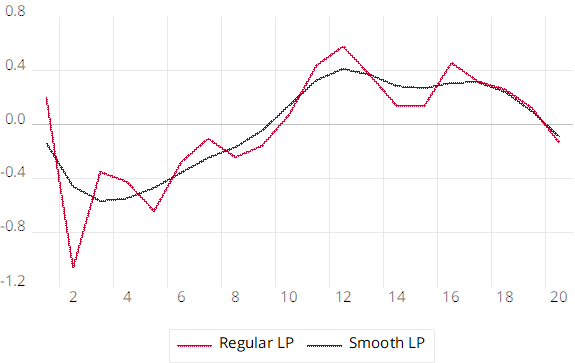
Local projections (LP) are nonparametric approaches, and they tend to be inefficient as their estimates frequently show considerable variability. In their paper, Barnichon and Brownlees (2019) propose a novel methodology for the estimation of impulse responses based on penalized B-splines called smooth local projections (SLP). They find that the SLP approach can deliver substantial improvements over regular LP, while preserving its flexibility.Smooth Local Projections
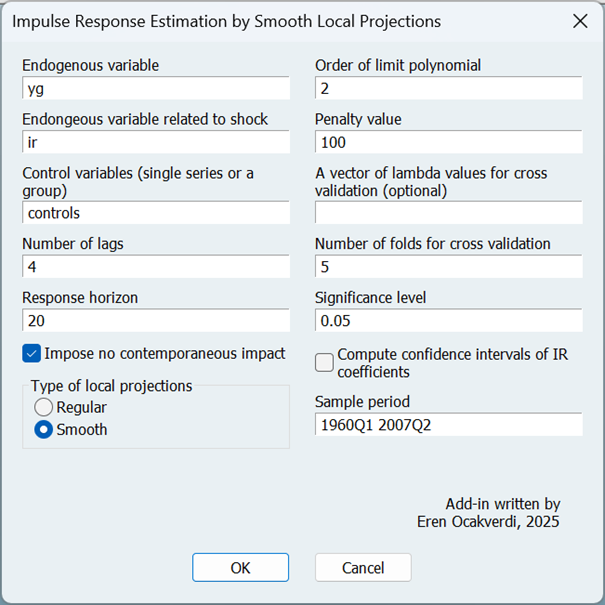
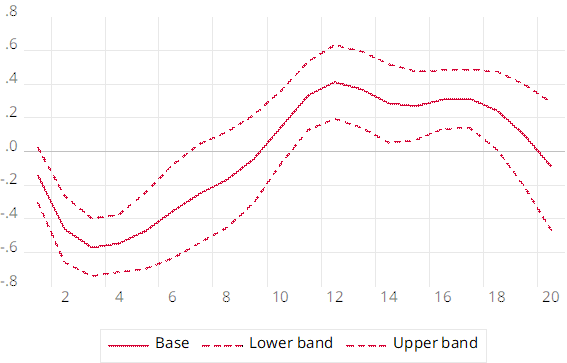
Regular LP recovers the dynamic multipliers, $\beta_{(h)}$, by estimating the following set of h-step-ahead predictive regressions via OLS: \begin{align*} y_{t+h} = \alpha_{(h)} + \beta_{(h)} x_t + \sum_{i=1}^{p} \gamma_{i(h)}\,\omega_{it} + u_{(h)t+h} \end{align*} However, overparameterization may lead to excessive variability in the estimates of dynamic multipliers. Authors propose an alternative methodology, where they approximate the coefficients using a linear B-splines basis function expansion in the forecast horizon: \begin{align*} Z_{(h)} \approx \sum_{k=1}^{K} z_k\,B_{k(h)}, \qquad Z \in \{\alpha,\beta,\gamma\}, \qquad z \in \{a,b,c\} \end{align*} Here, B-spline basis function is made up of $q+1$ polynomial pieces of order $q$. By using a particular family of penalty matrices $(P)$, authors shrink the estimated impulse responses toward a polynomial of a given order instead of shrinking toward zero like typical shrinkage estimators. The amount of shrinkage $(λ)$, which determines the bias/variance trade-off of the estimator, can be selected by $k-$fold cross-validation.Application to U.S. Monetary VAR Model
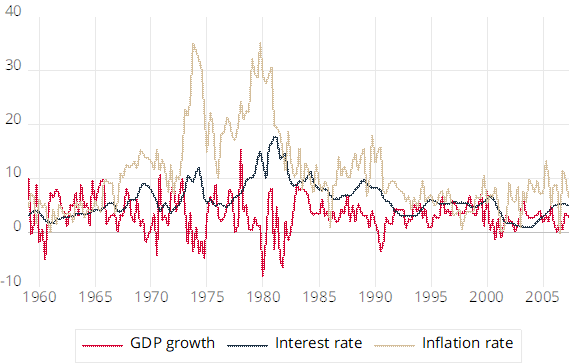
Example data uses the three-variable monetary VAR model of Stock and Watson (2001), where the inflation, unemployment, and federal funds rate variables used in that study are extended to cover the 1959q1-2007q2 period (see Figure 1).
 |
|
|
 |
|
|
 |
|
|
 |
|
|
Files
References
- Barnichon, R., and Brownlees, C. (2019), "Impulse Response Estimation by Smooth Local Projections", The Review of Economics and Statistics, v. 101(3), pp. 522-530..

hi Eren the workfile is not available could you share it, thanks Mario
ReplyDeleteThank you very much your wonderful job, Eren
ReplyDelete